
Estimated reading time: 26 minutes
Flying with kids can seem an impossible task, especially when long flights stand between you and your destination. From extra needs and tantrums to disrupted routines, it’s easy to feel stressed, particularly when traveling with our littlest companions.
After dozens of flights with our toddlers over nearly three years of full-time family travel, we’ve learned a lot about what works—and what doesn’t. We’ve gathered our best tips and tricks for flying with kids and compiled our practical survival strategies to help make long flights and airport days easier for the whole family.
Kids are unpredictable, and add in long security lines, flight delays, turbulence, and sleep challenges, and even the calmest parent can feel frazzled. Patience is key—not just with your children, but with yourself and your travel partner. We’ve had our fair share of tense moments on flights, but with a plan and a few clever strategies, traveling with toddlers can be manageable—and even fun.
In this guide, you’ll find everything from packing tips and entertainment ideas to ways to stay sane in the air, all designed to help your family enjoy flying together.
While we can’t guarantee this will always be the smoothest operation, I can assure you that there are ways to simplify the process and reduce the likelihood of a major meltdown.
You’ve got this, Mom and Dad!
Keep the kids entertained and learning on your travels!
Our digital kids’ activity books are packed with screen-free fun—coloring pages, puzzles, and fascinating facts. Designed for every stage of your trip, they include educational pages to prep before you go, activities and games for airplane or car journeys, and interactive pages to document their adventure with bucket list checklists, favorite foods, and spots to draw their favorite memories.

This blog may contain affiliate links. If you make a purchase through one of these links, I may earn a small commission at no additional cost to you. Any opinions shared are my own. Your support helps sustain our blog. Thank you!
Planning Ahead For Flights With Kids
Easy family travel starts long before you step on the plane. By planning ahead, you can anticipate challenges and organize your game plan, which is crucial for long flights with kids. This sets you up for a smoother journey from check-in to landing.
| What to plan | Why it matters |
|---|---|
| Flight timing | Helps kids sleep onboard |
| Airline choice | Some are more family-friendly |
| Stroller vs carrier | Impacts airport stress levels |
| Seating strategy | Can determine sleep + sanity |
| Packing entertainment | Prevents in-flight meltdowns |
Choose the Right Flight Time
When we have a long flight (like U.S. to Europe), we always try to choose an overnight flight.
If the flight is six or more hours, getting the kids to sleep is basically the goal. Entertaining kids for six-plus hours while keeping them seated and quiet sounds like a nightmare — because it kind of is.
Of course, there’s no guarantee they’ll sleep, but if you pick a flight that departs around their normal bedtime, chances are much better they’ll at least drift off.
Our toddlers usually go to bed around 8 or 9 p.m., so a 7:00 p.m. departure works well for us. Once we’re in the air, meal service starts, lights are still on, and that first stretch of the flight tends to go surprisingly fast.
If they don’t sleep, at least they’re eating slowly and distracted — which honestly still counts as a win.
If you don’t have an overnight option, try to match the flight to nap time instead. Even a short nap on a flight can completely change your experience.

PRO TIP
Our toddlers usually go to bed around 8:00 or 9:00 p.m., which makes our preferred flight time around 6:00 – 7:00 p.m. This timing works well because once we’re in the air, the flight attendants begin their demonstrations and serve food and drinks (usually). This part of the flight is typically the easiest to keep the kids engaged, and the first two hours tend to pass quickly for this reason.
But don’t stress about “perfect sleep.” Even just 1–2 hours of quiet wind-down time on a plane makes a huge difference. Think of it as buying yourself breathing room, not perfect bedtime success.
Select Family-Friendly Airlines
Most airlines are great with kids, even budget ones. However, there are some airlines that offer extras, such as bulkhead seats with bassinets and guaranteed family seating.
PRO TIP
We usually don’t rely on priority boarding — even though it’s offered — because we actually prefer boarding later. We’ve found that boarding last = less time contained in a tight space = fewer meltdowns (in theory… sometimes chaos still wins).
The downside is overhead bin space. You just have to decide which problem you’d rather risk.
Should you bring a stroller?
Short answer: yes.
We learned this the hard way on a 7-month Europe trip when we decided to go “light.” We ended up with a toddler on a rolling suitcase, a baby in a carrier, and two adults questioning all life decisions in the security line.
A stroller would’ve solved about 80% of that stress.
PRO TIP
Always gate-check your stroller, rather than checking it with your luggage, especially when you have a layover. This is particularly important for babies and toddlers.
Not having the stroller to navigate through security, customs, and airport terminals can turn into a nightmare. We’ve experienced countless meltdowns and problems after deciding not to gate-check our stroller.
Think about the long lines at security and customs, with toddlers running around and trying to keep them in line—it’s overwhelming! We’ve been there, and it still haunts us. Most toddlers can’t sit still, and being in a crowded line surrounded by strangers can be stressful, especially when it’s uncomfortably hot in the airport (seriously, why is it so hot in there!).
We researched a lot of strollers and even owned a double stroller at one point, but we ultimately chose the Babyzen Yoyo2 for our travels.
We liked it because it’s lightweight, folds up compactly with a carrying handle and bag, and has the option for the Babyzen Yoyo board. This board attaches to the back, allowing our oldest to sit and ride when she’s tired, but giving her the freedom to walk when she wants.

Requesting a bulkhead seat
If you’re traveling with a baby, check if your airline offers bulkhead seats with bassinets. That way, baby will have someone other than your arms to sleep on long flights.
We’ve done this with Aer Lingus. It was as simple as calling after booking to reserve the space.

PRO TIP
Even if you don’t use the bassinet, bulkhead seats are still worth it for legroom alone — especially on overnight flights.
Seat Selection
We rarely pay for seat selection.
Our go-to strategy:
- window + aisle.
- hope the middle stays empty.
And surprisingly, it works most of the time.
If it doesn’t, most passengers are willing to switch so a parent can sit with a child.
PRO TIP
For a family of four, window + aisle in adjacent rows is our favorite setup. It gives kids more space and often results in extra breathing room and space for the kids to move around and play with toys.
Avoid the back of the plane
If your child is sensitive to motion sickness, avoid the back.
We learned this the hard way.
The turbulence is noticeably worse, and it can turn a manageable flight into a rough one fast.
PRO TIP
We never fly without motion sickness medication anymore! Always bring a kid-friendly version on the plane and take before takeoff and landing.
Seating Policies
We almost always split seating:
- one parent per child.
Because if siblings sit together, they usually:
- argue over snacks.
- argue over toys.
- argue over existence.
PRO TIP
Some airlines charge fees for selecting seats, while others allow you to choose them for free. As budget travelers, we almost never pay for seat selection.
In fact, most airlines have policies that ensure young children are seated with an adult. Usually, for us, this means they either split us up, one parent with one child (our preference), or sit mom with both kids and dad somewhere else (his preference!).
In all seriousness, most airlines will seat children under a certain age with an adult. So, while we might not all be seated together, one parent will be with each child, and we can work with that.

Planning your first international trip with kids?
- How to Prepare for Your First International Trip: Essential Travel Tips, Packing Guide & Apps for New Explorers
- The Ultimate Travel Packing Checklist For Families
- Essential Travel Safety Tips for Traveling Abroad (Stay Safe Anywhere in the World)
- How To Travel On A Budget With Kids: Best Tips To Save Money
- Must-Have Travel Apps for Families: 25 Essentials for Easy Travel
- How to Travel Stress-Free With Kids: Our Best Tips
- Navigating Travel Health Insurance: What You Need to Know
Packing Essentials
Packing for kids requires more than just clothes—think snacks, entertainment, and comfort items. These packing tips for flying with kids will help ensure you have everything you need to survive long flights and minimize stress.
Carry-On Entertainment
Keeping kids entertained during a long flight can be challenging, especially since they’re confined to a small airplane seat. It’s essential to bring along items that can help keep them happy and quiet.
We fully support screens on flights.
We preload:
- shows.
- movies.
- games.
Because Wi-Fi is never guaranteed. We’ve been on flights where it simply didn’t work at all even when advertised.
We also:
- download Netflix content ahead of time.
- bring portable chargers.
- pack kid-safe headphones (volume limiting is a must).
- bring small toys and cards.
PRO TIP
Novelty is everything. A “new” toy lasts way longer than a familiar one on a plane.
Before trips, we let the kids pick a couple of toys at the store — but they don’t get to touch them until the flight.

Our favorite entertainment options for kids:
- Busy board
- Reusable Sticker Books
- LCD Doodle Board
- Amazon Fire 8 Kids Tablet
- Color Wonder Travel Activity Pad
- Color Wonder Mess Free Activity Pads.
- Toddler Montessori Busy Board
- Melissa and Doug Water Wow Reusable Activity Pads
- Open Ear Bluetooth Wireless Headphones for Kids
- Kids Toy Smartphone
- Kids Portable Charger
- Magna-Tiles 26-Piece Travel Set
- Apple iPad 10th Generation
- LED Telescopic Suction Cup Giraffe Toy

Looking for a full list of tried and tested travel essentials?

Snacks and Drinks
Always bring more snacks than you think you need!
Airplane food is unpredictable and kids are even more unpredictable. Pack some of your kid’s favorites to keep them happy and fueled.
We use spill-proof containers and always bring:
- snacks.
- backup meals sometimes (avoid nuts and foods that are temperature sensitive).
- refillable water bottles.
PRO TIP
Don’t rely on airplane cups – they’re easy for toddlers to spill! Make sure to bring refillable, insulated water bottles and fill them up after passing security and before boarding.
Comfort Items
Comfort items are non-negotiable for our kids.
We always pack:
- stuffed animals (usually only 1 per child).
- blankets (small, compact ones).
- favorite small toys (toy cars, small dolls, etc).
And yes — bring extra pacifiers for babies! We learned this the hard way. Somehow, they’ll be dropped and lost in the airport or fall and get dirty mid-flight with no way to clean them.
Bring extras. Then bring more extras.

PRO TIP
Consider dressing kids in pajamas for overnight flights. Our kids slept so much better being in PJ’s.
Wearing pajamas can signal that it’s bedtime, helping them to relax and transition into a sleep mindset, which is super important on long overnight flights.
We also recommend packing a sweater or an extra layer. We’ve noticed that flights often start warm but can get quite chilly once you’re in the air.
Secret Weapon: Sound Machine
One of our favorite travel hacks.
We use a portable Hatch sound machine.
It helps with:
- sleep.
- noise blocking.
- routine consistency.
We clip it to strollers or use it near seats on flights (but on a quieter setting) and of course in hotel rooms (particularly helpful for street noise when staying downtown).
Navigating the Airport With Kids
Airports can be overwhelming for little ones (and adults!). With a few smart strategies, you can move through security lines, check in, and board more efficiently, making your family’s travel experience calmer and easier.
Arrive Early
Give yourself plenty of time for check-in, security, and bathroom breaks to reduce stress.
The last thing you want when traveling with kids is to be rushing to the terminal because you’re late. It’s a worst-case scenario, especially with kids. We have almost missed flights before having kids, rushing through the airport with one of our bags unzipped, and dropping items along the way. It’s definitely not an experience we want to have with kids.
We aim for:
- 3 hours early minimum.
- sometimes 4.
Because something always goes wrong:
- check-in delays.
- bag issues.
- bathroom emergencies.
- security slowdowns.
- getting lost in larger airports (yes, this has happened, lol).
Personal Experience
Last year, while we were actively potty training, our oldest cried after waiting in the security line for half an hour when she had to go. We had to rush to find a bathroom to avoid an even bigger issue. Always factor in extra bathroom breaks, or account for the time spent searching for a restroom (we can never seem to find one when we need it!).
We were also delayed at the check-in counter because our bags were overweight (why you should always check weight BEFORE heading to the airport). Sitting on the floor while adjusting our bags and keeping track of two little kids is not something we would wish on our worst enemy.
On another occasion, we were shuffled between 3 different check-in counters trying to check our carseat (apparently no one knew where we were suppose to bring it, lol).
And this isn’t to mention the time we accidentally had a taxi drop us at the wrong airport terminal (which we only found out after waiting 45 minutes in the check-in line).
The bottom line is that anything can go wrong, and in our experience, something does go wrong every time. So be prepared and give yourself plenty of extra time.
Plan for Security
Security checkpoints aren’t enjoyable for anyone, and from experience, they can be some of the most stressful moments at the airport.
Different airports have varying rules:
- Should shoes be on or off?
- Do laptops need to be in the bag or taken out?
- Does the baby stay in the stroller or come out?
The experience can be nerve-wracking and often chaotic, especially when children are involved. However, there are a few things you can do to prepare and make the process a bit easier.
We prep before reaching security:
- liquids separated in one bag.
- electronics grouped (they didn’t like when our kids tablet was buried with her clothes).
- shoes off and ready.
- pockets emptied, belts off.
One parent handles bags and loading our things onto the belt and the other handles the kids, making sure toddlers don’t run off (which has happened before!).
Use Airport Amenities
Take advantage of family lounges, play areas, or nursing rooms if they are available.
We love airport lounges.
We use Priority Pass through Capital One Venture X.
Lounges give free access to:
- food.
- drinks.
- quiet space.
- kids play areas (some lounges).
- free massages (some lounges).
- showers (some lounges).
- printers and computer access.

Personal experience
We spent some time in a lounge at Istanbul Airport that had a children’s playroom. This playroom was complete with games, a slide, a climbing structure, a TV, and even camera connectors to monitors outside the room, allowing parents to keep an eye on their kids without having to sit inside. They also offered a large buffet selection, ensuring that even the pickiest eaters would find something to enjoy.
arriving at your destination.
Even if you don’t have lounge access, some airports do offer publicly accessible play areas for children. For instance, Vienna International Airport in Austria features a large play area with a huge climbing structure, slides, and a rock-climbing wall. During a long layover after an overnight flight, it was wonderful to let the kids run around and play while we relaxed with some coffee.
About Priority Pass Membership
Each Priority Pass membership allows free entry for one guest, and most lounges offer free entry for children under three years old. Our family of four has one Capital One Venture X card, with both of us listed on the account, giving us our own Priority Pass memberships. With these two memberships, all four of us can enter the lounges at no additional charge.
Lounges are an excellent place to relax before a flight. Enjoy a complimentary drink or meal, and let the kids burn off some energy in a play area if available. They are usually less crowded than other areas of the airport, providing more space and comfort to unwind before the flight. Additionally, most lounges offer computer and printing services, which are helpful if you need to print a visa or other documents before arriving at your destination.
To explore the best travel credit card options for your family, click here!
Stroller Considerations
Decide whether to bring a stroller or use a baby carrier based on the airport layout and personal convenience.
If you only have one baby, using a baby carrier can be a practical way to navigate the airport. However, we recommend bringing a stroller and checking it at the gate. With two kids to keep track of, a stroller is essential for us.
Even if you think you won’t need it — you will appreciate it!
If you have a long wait before your flight, you can use the stroller to carry your belongings (if it has a basket) and to help keep at least one of the kids contained.
Keep in mind that you will likely need to take your child out of the stroller when going through security.
As a side note, we always bring a stroller, one baby carrier, and one toddler carrier on our trips for our 2 and 4-year-olds. You never know what situations may arise, so it’s good to have options for comfort and convenience.

For baby carriers, we absolutely love the Ergobaby Omni360 and the Tula Toddler Carrier . Since we enjoy hiking, having both kids on our backs makes all the difference between a great hike and a not-so-great one. When the kids get tired walking, just pop them up on your back and keep going!
Packing a rigid hiking carrier isn’t practical for us, so these soft carriers are perfect. They fold up small enough to pack easily, or you can stuff them in the car seat or stroller bag when traveling, as we often do.
Airplane Survival Strategies
Once you’re on the plane, the real challenge begins. These survival strategies for flying with kids cover everything from seating arrangements to keeping them comfortable and entertained during even the longest flights.
| In-Flight Strategy | Why It Helps |
|---|---|
| Pack plenty of snacks | Prevents hunger-related meltdowns and keeps kids occupied |
| Rotate activities every 30–60 minutes | Helps prevent boredom and restlessness |
| Bring tablets or entertainment | Keeps kids calm during long stretches of the flight |
| Use headphones | Minimizes noise and distractions for everyone |
| Dress kids in layers | Helps adjust to changing cabin temperatures |
| Pack comfort items | Encourages relaxation and better sleep |
| Encourage movement when possible | Helps kids burn energy and stay comfortable |
| Keep kids hydrated | Prevents crankiness caused by dry cabin air |
| Plan bathroom breaks ahead of time | Avoids stressful last-minute situations |
| Use overnight flights when possible | Increases the chances of kids sleeping onboard |
| Bring a sound machine | Helps drown out noise and maintain bedtime routines |
| Separate siblings if needed | Reduces fighting and overstimulation |
| Keep essentials easily accessible | Makes diaper changes, snacks, and cleanups quicker |
| Stay calm during meltdowns | Helps kids regulate emotions more easily |
Engage Kids in the Flight Experience
Get the kids excited about traveling!
Involve them in the process by letting them help:
- pack the bags.
- choose their toys, snacks, and outfits.
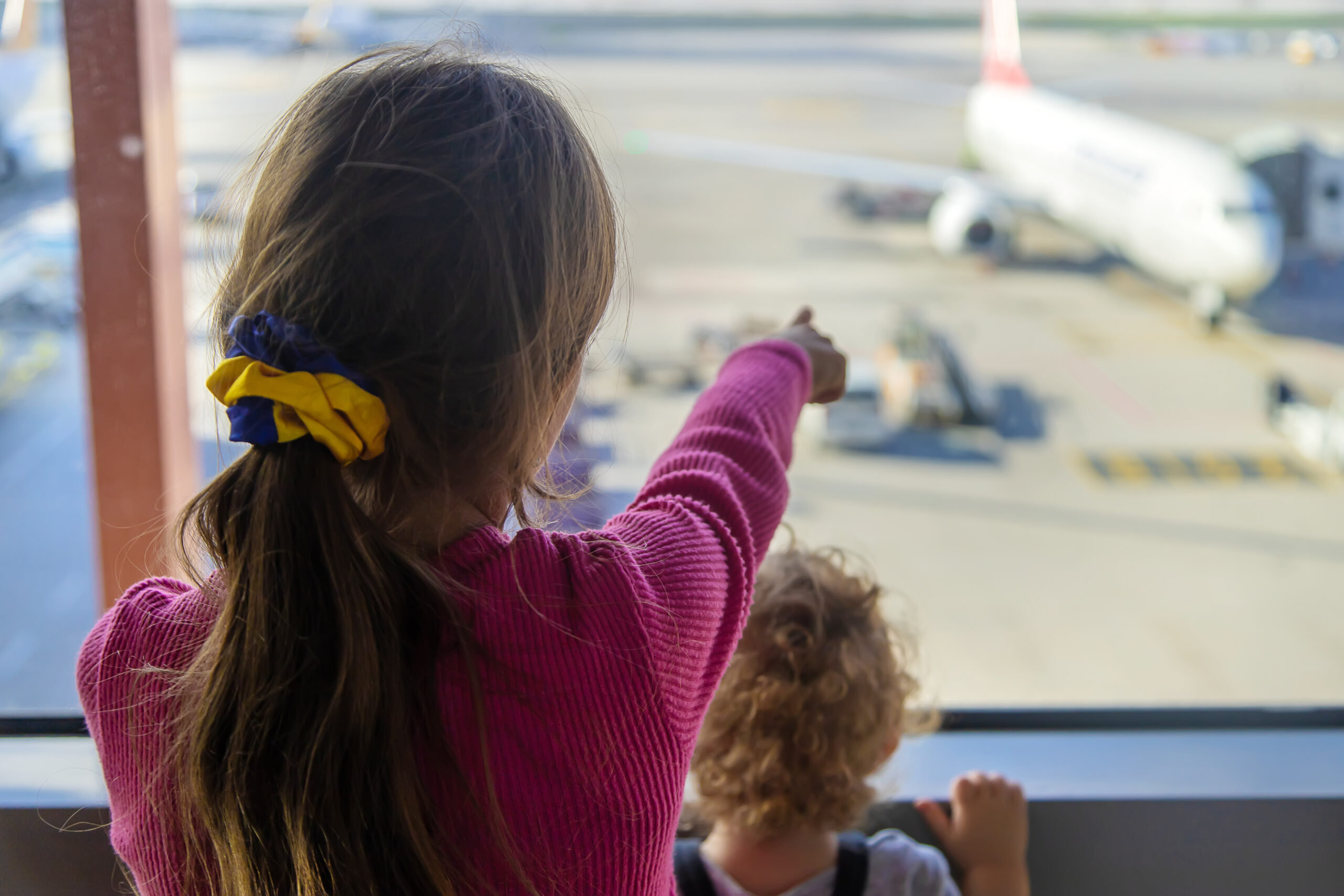
- watch the airplanes take off from the terminal.
Engaging them in each step can be especially helpful in reducing fear and anxiety, particularly if it’s their first flight.

Our oldest loves helping us push our luggage through the airport, and it’s always a bonus when we find a lounge with great views of the planes outside the window.
Tips to Keep Kids Comfortable and Entertained:
- Pack a small carry-on for each child with toys, coloring books, magnetic games, or a tablet with pre-downloaded shows and headphones.
- Bring plenty of snacks—more than you think you’ll need. Kids are picky eaters, and airplane meals don’t always appeal to little ones. Include a mix of familiar favorites and easy-to-eat options.
- Dress children in layers and pack a sweater or blanket, especially for overnight or long flights, as the cabin can get cold.
- Bring comfort items like neck pillows, small blankets, or favorite stuffed animals to help them relax and sleep better.
Practical Survival Strategies for the Flight:
- Keep kids hydrated with water or juice to avoid crankiness caused by dry cabin air. We recommend water only, as juice gets sticky when spilled.
- Relieve ear pressure during takeoff and landing with a bottle, sippy cup, pacifier, or gum (if age-appropriate). Or try child-safe pressure-relieving earplugs.
- Plan bathroom breaks before boarding and at key points during the flight; pack wipes and hand sanitizer for quick cleanups.
- Rotate activities every 30–60 minutes to prevent boredom: coloring, small games, or screen time.
- Consider seat swaps or extra space when possible—this can make naps or stretching easier. Sometimes the plane will have empty rows – always ask flight attendants before moving seats.
- Set expectations early by explaining the flight routine, meals, and safety rules to help reduce anxiety and prepare the kids, especially if it’s their first flight.
- Have an emergency kit with extra clothes, diapers, tissues, a small trash bag, and any medications within easy reach.
- Encourage calm techniques like storytelling, deep breathing, or quiet games during turbulence or stressful moments. Use what works best for your child.
- Align naps and sleep schedules with your destination’s time zone to minimize jet lag.
Frequent Breaks
Take breaks to stretch your legs, and let the kids do the same. Although it may be seen as a nuisance to other passengers, it’s perfectly fine for the kids to get up occasionally and walk up and down the aisles. As long as they stay quiet and don’t obstruct the flight attendants, don’t hesitate to let them expend some energy.
Before trying to help the kids sleep, make sure they take a bathroom break, especially if they’re still potty-training. You’ll likely find yourself using that small airplane bathroom more often than you’d expect.
Managing Meltdowns
Stay Calm and Acknowledge Their Feelings
We stay calm and acknowledge feelings first.
Most meltdowns come from:
- tiredness.
- hunger.
- ear pressure.
Use techniques to maintain your composure during stressful moments to set a positive tone. It can be overwhelming when a meltdown happens, but it’s important to remain calm and patient.
Perspective SHIFT
One of our biggest fears when we first started traveling with kids was the feeling of embarrassment or shame when our children had meltdowns in public. However, the truth is that most people, especially other parents, understand. Little kids are bound to have a bad day, tantrums are inevitable, and life goes on. Try to block out anything else and only focus on your child. If you’re having trouble staying calm, lean on your partner for support.
Have a Plan for Distractions
One of our favorite strategies for managing meltdowns and tantrums is the distraction technique. When we notice one of the kids getting upset, crying, or yelling, we implement a distraction. The distraction you choose should be tailored to what works for your child.
Prepare a list of simple distraction techniques:
- singing.
- pointing out things.
- silly questions.
- snacks.
- games like I Spy.
Sometimes simply pointing at something in the distance and saying things like, “Wow, what’s over there?” “What’s that?” or “Do you see that?” can work wonders for toddlers. You can also use more specific questions, such as “What color is that?” or “Do you see that airplane over there?”
Sometimes, the distraction is as simple as offering a snack or a toy. Other times, we can help them forget their distress by tickling them or making silly faces. The effectiveness of these techniques really depends on the child and the severity of the meltdown.
pro tip
There may be times when none of your distraction strategies will work. For instance, we once had an overtired 3-year-old trying to go through customs without a stroller. She threw herself on the ground in a crowded area and began kicking and screaming. This went on through customs and baggage claim.
Eventually, we got the stroller back and put her in it; she almost immediately fell asleep. Turns out all she needed was a nap. Travel days are hard on everyone, but especially the youngest travelers.
If a child is tired, you could try rocking them or holding them while walking up and down the aisles. Sometimes they just need a little help to fall asleep, especially when they’re overtired.
Arrival and Post-Flight
After a long flight with kids, the journey isn’t quite over yet. Between waiting to deboard, navigating a new airport, handling jet lag, and settling into your accommodation, the arrival process can feel just as exhausting as the flight itself. A little preparation and flexibility can make a huge difference.
Here are our best post-flight tips to help your family transition smoothly, minimize meltdowns, and start your trip on the right foot.
| Arrival & Post-Flight Tip | Why It Helps |
|---|---|
| Don’t rush to deboard | Avoids crowded aisles and reduces stress with kids |
| Wait to pack up until deboarding begins | Prevents kids from becoming impatient too early |
| Keep kids occupied while waiting | Helps avoid meltdowns during delays on the plane |
| Plan for jet lag | Makes adjusting to a new time zone easier |
| Keep kids on local schedule | Helps reset sleep routines faster |
| Allow naps carefully | Prevents overtired kids without ruining bedtime |
| Avoid overscheduling arrival day | Gives everyone time to recover from travel fatigue |
| Unpack comfort items first | Helps kids feel safe and settled quickly |
| Offer snacks and downtime after arrival | Eases the transition into a new environment |
| Expect extra emotions and meltdowns | Travel days are exhausting for everyone |
| Be patient and flexible | A calmer mindset makes the adjustment easier |
| Prioritize early bedtime | Helps the whole family recover faster |
Prepare for Disembarkation
Discuss the excitement of arriving at the destination to shift focus from the flight.
Get the kids excited about disembarking, but wait until the disembarkation process actually begins. Sometimes, you can end up on the tarmac much longer than expected. Disembarkation can be delayed, and you may find yourself stuck on the plane waiting to deboard. Once, we waited close to an hour!
It’s best to hold off on letting the kids know and start packing up until people actually begin to deboard. Allow them to play with their toys, continue sleeping, or stay otherwise occupied until it’s time to get up and go.
We often end up being the last ones off the plane, but we actually prefer it that way—unless we have a short connecting flight. Standing in line with a crowd of people trying to grab their belongings and slowly shuffling down the aisles can be challenging, especially with two little kids and their things.
Plan for Time Adjustments
Consider potential time zone changes affecting children’s moods and sleep patterns.
Jet lag is real and can be especially challenging for little ones. Adjusting to a new time zone can be difficult because it alters the body’s internal clock. Children’s bodies are typically more in tune with their sleep schedules than adults’. So, abruptly adjusting sleep and wake times can lead to significant behavioral issues, which in turn can affect your trip.
When we travel to a new time zone, we try to avoid planning any activities on the day of arrival or the following day. If you’re taking a short trip, you might not have this luxury, but if possible, it will greatly help in the long run.
Jet lag strategy
The best strategy is to stay awake and maintain normal sleep hours. Allow the kids to nap, but be careful not to let them nap too much. If they sleep all day, they may struggle to fall asleep when the sun goes down. While they will likely be tired and may have more meltdowns than usual that day, it ultimately works out better in the long run. Just don’t let them sleep too close to their usual bedtime.
If you arrive in the early morning hours, let them nap for no more than 3 hours during the daytime and try to keep a 4 our wake window before bedtime that night.
Unpack Comfort Items First
Settle children in with their comfort items as soon as you reach your accommodation to ease transitions.
It’s best to unpack right away and set up all your kids’ favorite things. Make sure to unpack their comfort items, such as stuffed animals and dolls, to help them feel comfortable and relaxed. You might also consider putting on a movie or giving them a snack.
Everyone will be exhausted, and it’s completely normal for the initial excitement of the trip to wear off. Take time to rest and recharge, be patient with each other, and try to get to bed early.
You’re sure to sleep well after this long day!
Embrace the Chaos
Traveling with your kids is a wonderful experience. It allows you to share the world with them, engage in unique experiences, educate them about new cultures, and enjoy breathtaking scenery. However, to enjoy these amazing moments, you first need to get there! Flying with little ones can be challenging and is often not the most enjoyable part of traveling. But, with proper preparation and a reasonable amount of patience, it doesn’t have to be a complete disaster.
We hope our tips and tricks for flying with kids helps you feel more confident about traveling with your kids and provides you with the insights needed to plan your next journey.
Remember to keep on traveling!

Leave a Reply